skip to main |
skip to sidebar
 Okay this is true, I know it because the HIStory Channel never lies. There's this parasite, loves spiders innards, and when it burrows into the stomach parts the spider starts to feel poorly. This parasite is called a leech-miasis.
 So it starts to get fat inside the spider until the poor insect is in agonies of pain. Now, the spider lives with a seeming knowledge that it will die if it falls into water. But I saw it jump right into a
 pool of water with what (anthropomorphically) looked like purpose. Surely it knew it was carrying a parasite? I don't know, but somehow must've known it would die in the effort, and chose death rather than live with such pain. The film showed how the parasite crawled out of the spider as it died.
If true, what does the ability of other animals to understand suicide tell us about life? Even more poinant, what does it say about sacrifice, not just blind instinctual action?  Remember the elephant matriarch who threw herself in front of a pack of wild dogs to save her sister? No, not to distract, she tried that. She tossed her weight onto the dogs by throwing her immense bulk onto the ground. They tore her up pretty badly but she accomplished what seemed her goal: saved her sister. Gave her life. Just laid down. I know it sounds (again) very personally anthropomorphic but what a concept - humanity in other animals.
I like it. Might mean there's hope for us.
 "I SAID I LOVE THIS COUNTRY DAMN IT NOW GO SIT ON A FIRECRACKER AND GET OUTTA MY FACE IF YOU DON'T LIKE IT YOU CAN LEAVE !!!!"
 America ....... America ...... God shed His grace on thee......please!?
 You are looking at a total solar eclipse isn't it fascinating? This thing, this star we call the Sun, and in latin is "Sol" makes our "Sol-ar" system the miracle it is. Without the gravity of this actually quite mediocre star, there would be no galaxy. Does that mean there would be no life?? That is exactly what it means. No life.

 "Sol" is a star like many others its size, it's like a tiny nuclear reactor plant, using fusion to operate. If this planet were only a few inches closer or farther away, life couldn't have taken footholds here. That always makes me wonder exactly where WOULD it have started, if not here - on Earth. IF AT ALL. We've found the building blocks, the nitrates, the microbes, even the frozen water, but not the life we seek. Only here. And the Sun could wipe us out. Actually, one day it will - but humankind will have gone extinct by then, probably the last to extinguish.
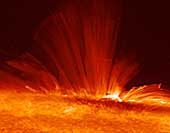
 And look at this Solar flare, doesn't it make you feel small and helpless against such forces? Amazing.
 This is the moon as it "transits" or moves across the face of the Sun. It took over 12 hours to make the complete trip.
 Can you see the light at the center of this nebula? It's coming into being - all those gases and dust clouds, all that space debris forming odd shapes and mysteries in our minds. Nebulas are nurseries for stars, this is where they're born.
 Here's an X-ray image of the Sun, you wouldn't even recognize it otherwise. And this was taken while the Sun was "quiet" how incredible.
 So restless, this unquiet star, Such power.
I truly believe the ancients knew something about this orb of magic and wonder. What did they know that we may've forgotten?
 Look closely as VENUS transits the Sun. See it?
If nothing else, we owe this star our everlasting WONDER.
 It's so incredible - our trusty eye in space is still taking and obeying commands. One of the most astounding, remarkably powerful astrological facts we've uncovered is that we know nothing. Nothing.
 There's so much "dark matter" in the known universe I can't begin to estimate how many places life must have taken hold in other galaxies.
But here's a thought, not ignored by many cosmologists:
 WHAT IF "LIFE" AS YOU AND I KNOW IT WAS A FREAK ACCIDENT?
When you examine how carbon-based life began here, from some early cosmic thunderbolt into an expanse of ocean, igniting the first nucleated cell, which replicated and sat in the primordial ooze, the tiny one-celled creatures becoming multi-cellular, replicating all over the place until they formed a mosquito, how incredibly random does that sound? So so random.
 Almost TOO random.
Maybe the most accidental things are really well-planned out chaos.
The theory of chaotic discipline in the universe isn't new, and it's very ponderous - maybe we humans are thinking a bit too much about it all.
 Life - so far as we know - has not occurred anywhere else but here.
I know, you're thinking of water. Where's there's water, life can flourish.  You're thinking of the polar ice caps of Mars, or Neptune. But that's not frozen water, it's permanently solid gas - mostly methane. There's just no proof that liquid water ran freely on Mars or anywhere else we've been able to explore. Except here.
And we don't understand any other life but water and carbon. On this planet there are 3 forms of life and no more: animal, vegetable and mineral. No silicone-based life, no floating gas-based life.
So picture what a creature on Jupiter would look like: It's a gas giant, any life would be gaseous, perhaps like a blown up jelly-fish sort of structure with tentacles to reach out and grab "food" from the gas clouds. What food?
 As I look at this planet from the vantage of space, I have to wonder:
Was this all one big accident?

 Okay this is true, I know it because the HIStory Channel never lies. There's this parasite, loves spiders innards, and when it burrows into the stomach parts the spider starts to feel poorly. This parasite is called a leech-miasis.
 So it starts to get fat inside the spider until the poor insect is in agonies of pain. Now, the spider lives with a seeming knowledge that it will die if it falls into water. But I saw it jump right into a
 pool of water with what (anthropomorphically) looked like purpose. Surely it knew it was carrying a parasite? I don't know, but somehow must've known it would die in the effort, and chose death rather than live with such pain. The film showed how the parasite crawled out of the spider as it died.










 Posts


